
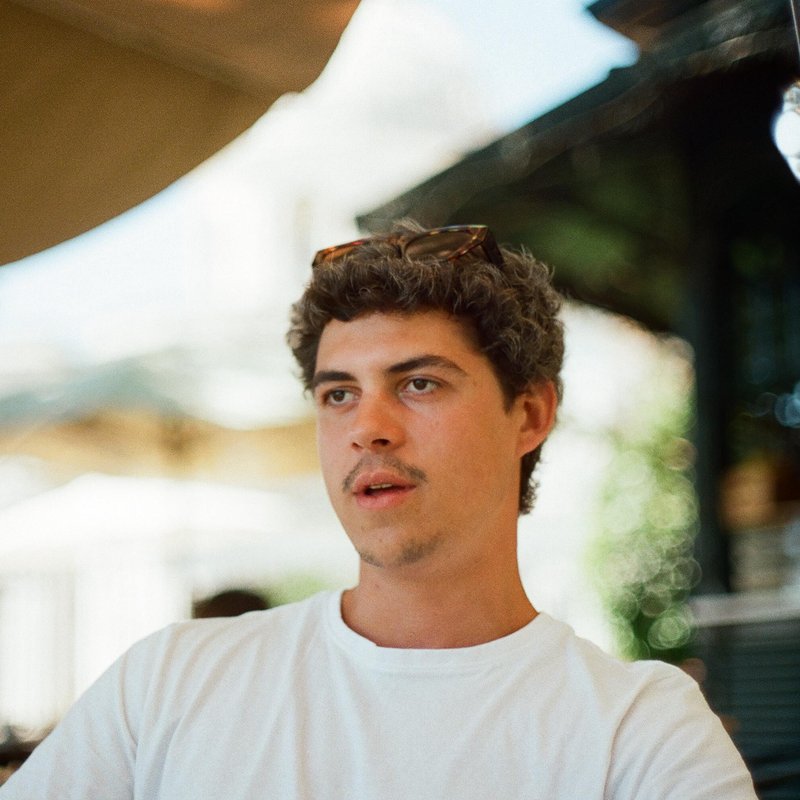
I met Rodrigo through a mentoring chain.
For years, I mentored Pedro Andrade across several startups. Today, he’s CEO and co-founder of Humanos, a trust-focused startup. When Pedro introduced me to the team, I was impressed.
I connected with Rodrigo immediately. I saw the product instinct and the unmistakable “yes” of a mind that can’t stop asking better questions.
He has bright eyes, relentless curiosity, and a rare comfort with falling down and getting back up. I often say I’m a better spotter than a mentor, and I had the same instinct about Rodrigo as I once had about Pedro.
As he moved into product, we began talking regularly. I was impressed by the quality of his questions, but the discipline behind them. He listened. He built on what came before. And then he executed. By the next call, the ideas were either already in motion or deliberately dropped.
When I invited him to Reinvention Stories, he hesitated. “I’m not sure I’m a good representative of my generation.
Then I learned why. Six years ago, Rodrigo quit social media to protect his mind from algorithmic bias. While most people optimize for visibility, he optimized for intellectual independence. That’s rare at any age.
What also stands out is how Rodrigo learns. He starts with a goal, moves quickly into doing, and uses each iteration to refine the underlying theory. The result is a rare blend of pattern recognition and symbolic thinking, connecting what matters without forcing it. It is the kind of thinking that helps people learn faster, especially when learning happens inside the work itself.
It’s reassuring to see Rodrigo working on trust at a time when reality and simulation are blurring.
Gus
Bird’s Eye View
Can you give us a glimpse of your life story?
I was born and raised in Graça, a very authentic and local neighborhood in Lisbon. My world was small and dense, with most of my family close by, schools five minutes from home, and friendships forming almost naturally through neighbors, shared schools, and sports clubs. From a very young age, my parents taught me that stability and success come from hard work, and they live by that principle themselves. Watching and listening to them made it very clear to me that effort eventually turns into results, even if that relationship takes time.
As far back as I can remember, I was always wanting something and trying to figure out the best way to get there. That could mean helping at the local grocery shop, carrying bags to old ladies’ homes in exchange for a few cents, or making homemade bracelets and selling them at school. Most of it was usually to achieve the goal at the time: saving up for the next Star Wars Lego set I wanted.
I was also very active, and sports played a big role in my life: swimming, basketball, and especially athletics. Before competitions, I would get extremely nervous, mostly because I didn’t want to fail. Choosing to suffer, to experience pain, and to push myself to my absolute limit felt more natural than walking away from a goal. Athletics, which was the sport I took the most seriously, really taught me, through experience, that to achieve something we really want we have to suffer and abdicate other things we like.
From early on, I was drawn to numbers and structure. I loved mathematics, which made economics feel like a natural and exciting path, also influenced by my aunt and uncle working in banking. In high school, I chose economics over a more traditional sciences track, even though the pull toward science was always there. That loop eventually closed when I enrolled in a Data Science course, which was completely new in Portugal at the time, after someone casually mentioned it to me. Before committing, I started learning Python on my own to see if I liked it enough. I fell in love almost immediately, after writing my first function — and no, it wasn’t “Hello World.” Realizing I was good at something I genuinely loved, and that was also valued and recognized by society, was a turning point. It gave me a foundation I could truly build on.
Once I found that direction, I became very intentional about pursuing it long term. During university, my main focus was improving my skills as much as possible, even if that meant making choices that felt unusual at the time. I didn’t prioritize expanding my social circle, and I willingly gave up experiences I wanted, like going on Erasmus, taking certain trips with friends, or even playing video games. I was comfortable giving up parts of the present because I believed it would allow me to operate at a much larger scale in the future.
After being a researcher for almost three years, I realized that the academic world wasn’t where I wanted to stay. I enjoyed the practical side: building systems, making things work, and solving concrete problems. What drained me was everything around it: writing state-of-the-art papers, endlessly adjusting reference formats, and optimizing for academic conventions rather than real-world impact. Luckily, I met people who exposed me to the entrepreneurial world, and that completely shifted my perspective. I found a way to really apply what I was more passionate about, building — and also have a lifestyle that is intrinsically connected to my values: effort, curiosity, change, flexibility, and planning.
I’m always aiming at something, but the goal itself is never fixed. The path adjusts, bends, and shortens as I learn more, and I try to adapt rather than resist it. I need new challenges, both professionally, in relationships, and geographically, to stay engaged. Effort and drive have been essential in navigating the uncertainty of life, but I also recognize the role luck played in my life. Luck really exists; all we can do is stay alert and have the courage to embrace it when it appears.
You moved through very different worlds in Lisbon. Now you live abroad and may move again. How does diversity impact you?
Diversity has a very direct impact on the way I grow and make decisions. I see myself as the cumulative result of all the experiences I go through, the people I meet, the places I live in, and the ideas I’m exposed to. If I want to expand myself and push my limits, I need to constantly add new inputs to that equation. For me, diversity and discomfort are closely linked. Whenever I place myself in a new environment, with new people or unfamiliar ways of thinking, I’m forced to adapt. That adaptation is uncomfortable, but it’s also where growth happens.
Comfort, on the other hand, comes from predictability. Routine, normality, and familiar environments allow me to react almost automatically. There’s value in that too. Comfort helps solidify what I already have. It strengthens existing skills, refines opinions, and deepens knowledge. It’s like staying with the same author long enough to truly understand their thinking, instead of just discovering a new one.
Diversity does the opposite. It adds something new to me. A new perspective, a new habit, a new way of interpreting the world. It expands my boundaries rather than reinforcing them. Because I actively seek that kind of expansion, diversity naturally impacts my life choices and daily decisions.
At the same time, constant exposure to different cultures, opinions, and value systems also comes with a trade-off. When you’re surrounded by many valid ways of seeing the world, it becomes harder to hold strong, fixed opinions. Your sense of identity becomes more fluid. Sometimes I feel like I belong everywhere and nowhere at the same time. I’m shaped by many places, but not fully anchored to just one.
Learning and Reinvention
What does learning mean for you? And how do you learn?
Learning is everything to me. It’s the way we understand the world around us and, just as importantly, the world inside us. We learn how to walk, which gives us freedom of movement and exposes us to more experiences, but we also learn how the outside world affects us internally and what mechanisms we can use to adapt or protect ourselves.
I’ve always been fascinated by knowledge, and accumulating it is one of my biggest life goals. In a broad sense, I learn by placing myself in new situations and environments that expand my understanding of reality. Diversity plays a central role here, because exposure to different people, cultures, and contexts constantly reshapes how I see the world.
When it comes to more technical or theoretical knowledge, I learn mainly through doing. Theory is a necessary starting point, but I only truly understand something once I apply it in practice. With AI now deeply integrated into my work, this process has become even more pronounced. In the past, learning something like mathematics required understanding the theory before I could even begin practicing. Today, AI allows me to start with a goal and move straight into execution, learning and internalizing the theory along the way.
I’ve always enjoyed practical work and execution. Seeing something take shape over time motivates me and keeps me engaged. AI has accelerated that process by increasing my level of involvement and feedback. That said, it has also shifted the type of knowledge I consolidate. I’ve become stronger at understanding high-level systems and interactions, while some very specific, manual skills, like low-level coding practice, have naturally decreased. Still, that trade-off allows me to reason about and build systems at a scale that wouldn’t be possible through manual execution alone.
What did teaching older students so early teach you?
Teaching at ISCTE-IUL so early was one of the experiences that shaped me the most. I started around 20, mostly because I genuinely enjoyed coding and naturally found myself helping others during practical classes. After doing that for a while, proposing myself as an assistant felt like a natural step rather than a calculated move.
I only felt comfortable doing that because of the relationship I had with my professors. There was no heavy hierarchy, just a very human dynamic. They treated students as peers in the learning process, and that left a strong mark on me. It showed me that authority doesn’t come from distance, but from clarity, respect, and competence. That mindset stayed with me far beyond the classroom.
When I started teaching, some of the students were older than me, but age never really mattered. What became obvious very quickly was how differently the same idea could land depending on how it was explained and who was on the receiving end. Teaching forced me to accept that there is no single correct way to communicate a concept. People understand, absorb, and engage with knowledge in very different ways.
It also taught me a lot about humility. I always appreciated professors who spoke at eye level and openly acknowledged their own struggles, so I tried to do the same. Being honest about the difficulties I had faced just a couple of years earlier made the learning environment more relatable and, I think, more motivating. I became very aware of how central motivation is to learning. When someone doesn’t connect with the subject, progress becomes slow and forced.
More than anything, teaching showed me that it’s one of the best ways I have to learn. Having to explain something again and again, and being challenged by unexpected questions, pushed me to rethink ideas I thought I fully understood. Over time, that process gave me a much deeper and more solid understanding of my own knowledge.
Tech & Trust
Trust is a messy, human instinct. Can it be coded, or are we just building better illusions of safety?
Trust is indeed a messy, deeply human instinct. Before asking whether it can be coded, it helps to clarify what trust means to me. I see it as a rational construct that allows individuals or systems to interact while minimizing the risk of harm. Nothing people, actions, or systems ever shows its full essence to the world. Everything is presented through a mask.
For me, trust grows as the distance between that mask and what lies beneath it becomes smaller. It’s not about blind belief, but about reducing uncertainty. In that sense, trusting and not trusting are equally important. What matters is the ability to look past what is projected and make informed decisions based on what is actually there.
Between humans, that gap is incredibly hard to measure. Our masks are built unconsciously, shaped by context, incentives, and emotion. With AI, however, we’re facing something different. AI systems operate in conditioned environments. They’re trained on defined data, follow explicit instructions, produce logs, and pass or fail tests. Their mask can be constructed directly from how they behave in the world and continuously updated, making that gap smaller and more observable.
Building trust between humans and AI, then, is less about belief and more about structure. It means encoding actions, instructions, decisions, and authorizations in a way that reflects real-world complexity while remaining interpretable by machines.
At Humanos, this is exactly the problem we’re working on. We’re building infrastructure that enables trust between humans, automated systems, and AI through an open-source standard based on the idea of a mandate. A mandate is a portable, auditable, and cryptographically verifiable artifact that encodes authority and intent. These interactions all have scope, intent, authorship, time, and rules, and they only generate trust if they can be verified and understood by others.
I do believe trust can be coded, but not human trust. Trust is a living concept. As we enter the AI era, we’re not replacing it. We’re creating a new form of it.
Becoming CPO at 23 is unusual. What helped you earn trust fast, and what was harder than people assume?
Becoming CPO at 23 wasn’t something I had trained for in a traditional way. I didn’t come from a product background, my foundation was mostly technical. Teaching played a big role in bridging that gap. Having to explain complex ideas to different people taught me how to listen better, spot where misunderstandings come from, and adapt my language to simplify problems. Those skills transferred naturally to product, where understanding needs and communicating them matters more than frameworks.
I’m naturally inclined toward planning, design, and organization. I enjoy thinking in systems, structuring ideas, and quickly turning them into prototypes. At the same time, being comfortable with constant change is essential in product. One of the biggest lessons I’ve learned is that good products are shaped more by removal than by addition. You need to explore new features, test them, and listen to feedback, but also be willing to take things away when they don’t truly add value.
What’s harder than most people assume is the constant mental switching. My days move quickly between very different modes: planning, managing the team, meeting with clients, making product decisions, and jumping into code to fix or test something. Each of these requires a different way of thinking, and shifting between them takes effort. I might fix a bug, jump into a client meeting to capture a new need, update the roadmap, review a pull request, and then immediately run a demo, all in the same hour.
That cognitive collision is demanding, but it’s also what I enjoy most. The diversity, the constant change, and the need to adapt in real time are what keep me engaged.
Off the grid
You sit at the intersection of cold logic (crypto/AI) and deep emotion (music/arts). Where do these two sides of you collide, and where do they feed each other?
This is a question I’ve spent some time asking myself. Logic and creativity are often seen as opposite ends of the same spectrum. But I don’t think this is true, and the world has presented us with a set of unprecedented examples, such as Socrates, Newton, Beethoven, and many others. All of them were extremely good at combining these two human forces to completely rupture with what existed before.
Our minds aren’t divided into silos. When one skill deepens or a new way of seeing emerges, it tends to influence everything else, even if subtly. My relationship with the arts, especially music, has pushed me to explore creativity more intentionally. That creative training then feeds back into my professional life, shaping how I approach problems, ambiguity, and open-ended challenges.
At the same time, working with logical systems like coding has taught me the value of structure and method. That discipline doesn’t stay confined to work. It also informs how I learn music, how I practice, and how I make sense of the arts.
Where these two sides collide is often where I feel most engaged. Logic and structure give creativity something to push against, and creativity prevents logic and structure from becoming rigid. Rather than pulling me in opposite directions, I try to apply my energy to things that combine both of these forces.
Quitting social media early is a radical act for your age group. What are you enjoying most about living life without an audience?
Once I tried to spend one summer without personal social media. Three months quietly turned into more than six years. The first thing I noticed was time. Suddenly, I had a lot more of it. I started using that time to read more and focus on things that genuinely added value to my life, like music, improving my programming skills, working on personal projects, and spending time with myself and with people offline.
Social media platforms have become the norm and have a massive impact on people, both positive and negative. I felt that, over time, they would end up affecting me more negatively than positively. Nowadays I see people spending a huge amount of their free time on them, sometimes 4 hours on average. I am glad I stopped before getting to this point.
Another major reason was algorithmic bias, a concept I was exposed to early on at university and that had a strong impact on how I think. I didn’t want my curiosity and opinions to slowly narrow based on what I click, search, interact with, or even pause on for a couple of seconds. I wanted to stay exposed to a more diverse, less curated set of information, even if that meant consuming less of it. That’s why, even today, I keep platforms like YouTube with no history, no recommendations, and no shorts enabled. I may watch fewer videos, but the ones I do watch are intentional.
Although living without an audience wasn’t my main reason for quitting social media, it became one of its most meaningful consequences. I didn’t lose my audience, it just became smaller and more real. Without the constant background noise of posts and updates, I naturally focused more on my inner circle and let go of connections that were mostly based on visibility or habit.
To be completely honest I now have X for product and technology updates.
Is music your escape from the logic of your work, or is it just another complex system you’re trying to decode?
Both! Music is by far my favorite hobby, it brings a lot of energy into my life, whether I’m playing or simply listening. It activates a part of me that isn’t logical at all, it reaches somewhere below the mask.
At the same time, music is also a system. There’s structure, physics, and patterns behind it, and I take real pleasure in trying to understand how those pieces fit together. I tend to learn music in a very methodical way, breaking things down and analyzing them, much like I do in my professional life.
Lately, though, I’ve been feeling the need to move away from that structured approach. I want to learn music more through interaction, playing with others, in real time, and adapting to what’s happening in the moment. Understanding how to place yourself and your musical ideas within a shared environment feels like the next step for me. So I really want to move away from using so much logic and explore more the creative side.
Past and Future
What’s the hardest lesson you’ve learned so far?
The hardest lesson I’ve learned has been learning to separate planning from expectation. For a long time, the two were tightly linked for me. Planning, in my mind, is the process of exploring multiple paths to reach a goal. It takes time, changes constantly, and demands both cognitive and emotional effort. The problem is that this internal exploration can move your mindset very close to the outcome you want, even when reality doesn’t follow. That gap between where you mentally arrive and where things actually are can easily turn into frustration.
Individual goals tend to be less uncertain, because we know ourselves better than anyone else. Most meaningful goals, however, are social. They depend, directly or indirectly, on other people. Humans are unpredictable by nature, and maybe that’s one of the things that will always distinguish us from AI. I’ve learned that when my plans and ambitions involve others, I need to lower my expectations. Not because I don’t trust people, but because I try to stay realistic.
Professionally, I’m very lucky. I work with people who are as driven as I am, if not more. We work efficiently, in an environment filled with jokes, laughter, and hard truths. For the first time, I feel I’m building something with people who don’t add uncertainty, they reduce it and make me more grounded.
Which big questions do you have on your mind currently?
How is AI going to shape our society and redefine human purpose?
How can I actively improve my memory?
Where do I want to move next and what do I hope to find there?
What is meaning? Do I have one? Do I still need to find it? Or does it simply not exist?
How do you face the future? Do you make plans for it?
We’re living in very uncertain and, at the same time, incredibly exciting times. Above all, I face the future with curiosity. Technological evolution has been accelerating since the industrial revolution, but with AI that acceleration feels unprecedented. I’m convinced our lives will look very different from what we know today. As with any major shift, there will be positive and negative consequences, and I see it as our responsibility to actively contribute to that future and find where we fit within it.
AI is evolving fast, but it’s still far from being fully integrated into society. Technology alone isn’t enough. Humans need to understand how to use it, as well as its risks, limitations, and strengths. Because AI is still in its early stages, this is the right moment to start building the structures that create confidence and place meaningful boundaries on how it acts in the real world.
My main focus is to keep building infrastructure that allows AI to have a positive impact across different areas of society, from healthcare and law to education, transportation, and the environment. For that to happen, humans need ways to interact with AI seamlessly and safely, treating it as a trustworthy party for task delegation. That’s what we’re building at Humanos, a foundational piece of the AI stack aimed at improving how AI integrates into our society.