
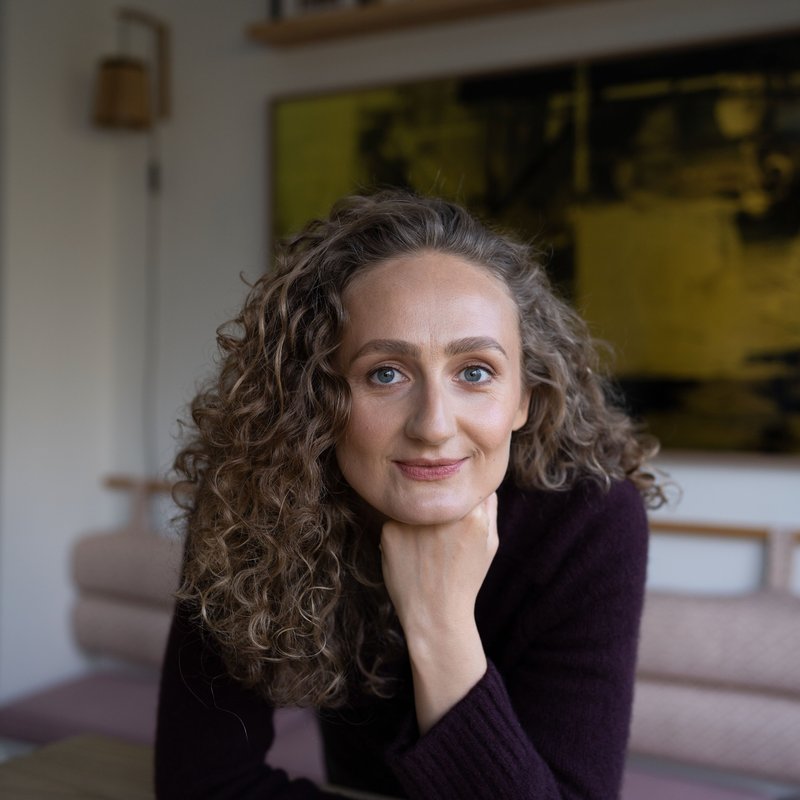
I first met Galina over a quick lunch through a mutual connection. Within minutes, I knew we needed to have a deeper one-on-one chat. Our paths didn’t cross again immediately, but serendipity (and The Breakfast App) created that chance.
Our conversations flow naturally into deep waters, exploring human connection, joy, and the beautiful complexity of living outside society’s conventional boundaries. Ironically, lately, I’ve been appreciating the comfort of some boxes, but that’s a rabbit hole for another time.
Meeting new people has always been my favorite experiment. I love those first moments when different worlds collide and new connections form. Yet Galina’s story of arriving in rural Tennessee at 15 showed me what real culture shock looks like. Picture yourself as a teenager in 2000, armed only with British English textbooks in an American high school, where conversations about Parliament and the Queen didn’t exactly break the ice.
There’s something magnetic about how Galina thinks. Her mind follows precise paths until, without warning, she drops an observation that makes you question your own thought patterns. It’s like watching someone who knows the playbook but decides there’s no playbook.
Grab your favorite drink and get comfy. You’ll hear from someone who tried many “life packages” before creating her own.
Gus
Bird’s Eye View
Can you give us a glimpse of your life story?
I now think of my story as one of coming to the realization that we are here to create and more importantly experience our own ‘life design.’ I started off by thinking that life comes in these pre-made packages (I call them IKEA packages), success stories that we inherit and we either want to fulfill them, or disprove them; in both cases, we are actually basing our lives on these defined paths.
At first, it was about finishing university, moving into a corporate career, and climbing the ladder. After some time, I realized that this path didn’t fulfill me. That’s when I assumed that the corporate life just wasn’t for me and decided to try entrepreneurship.
It felt like I was picking “IKEA life packages” — trying to fit myself into pre-made templates or life paths. But eventually, I reached a point where it just didn’t work. Now, I’m focused on creating a life that aligns with my values and the experiences I want to have, rather than trying to fit into someone else’s idea of success.
How did living abroad as a teenager shape your views on cultural diversity and human connections?
This experience was truly pivotal in my life. I had just turned 15 when I went to study at a high school in a rural area of Tennessee, back in the year 2000. At that time, the internet wasn’t around much, and I didn’t have access to TV shows or much of the local culture, so I was speaking this very British English we learned in school — talking about topics like Parliament and the Queen — which didn’t help much when it came to communicating with teenagers.
Two major lessons stand out from that time. First, the experience of adapting to a completely new environment at that age was a huge shock. The first three months were incredibly difficult; there was a time when I cried in the bathroom every day before going to school. I failed at something every single day. But looking back, I feel that the experience of failing and opening up to the environment through that led me to build a lot of trust in myself.
The second key lesson was learning to see people as people. Might sound easy, but I believe most of our problems might be solved if we are able to view life from this level — deeply interpersonal. While we all come from different cultural contexts, with various perspectives and experiences, beneath it all, we share basic human ‘backend’. Dropping down to that core human level helped me build meaningful connections, no matter where I found myself. Ultimately, this realization — that no matter where I go, the people I meet are also just people — became crucial in helping me navigate new environments and establish genuine human connections.
Learning and Reinvention
What does learning mean for you? And how do you learn?
I believe learning (in the broad sense of acquiring new experiences) is the purpose of life. The goal is to end differently from how we started, and learning is the path that makes this possible. It’s not about formal education — what we’re taught in school or university — where the focus is often on acquiring knowledge to become a ‘valuable’ part of society.
Instead, I see learning as a journey of being open and curious. I’m very experiential in how I learn. While I love research, reading books, and building intellectual concepts, I know that true learning happens through the exchange of knowledge with others. I learn from people, through conversations and by discussing my views and visions. We live in this big ‘Legoland’ where we are here for each other, and to create anything, you just need other people to build with you.
I think of learning not as mastering information and acquiring knowledge, but as a process of experiencing reality, connecting with others, sharing perspectives, and transforming our collective environment — in other words, evolving.
What’s your strategy for approaching major career transitions?
My initial approach to career transitions was about choosing the right pre-made “IKEA package.” I would jump from one path to another — starting with a corporate career, then switching to entrepreneurship when the corporate world didn’t work for me. These shifts were often quite radical, driven by the belief that I just needed to find the “box” that fit me.
I realize now that I will not experience the feeling of true satisfaction inside any of these packages. I am allowing myself to embrace the uncertainty and use my internal navigation system instead. It’s a gradual process.
Now, in the process of another major career transition, I am approaching it differently. For the first time, I allowed myself to take time off — absolutely no work, just rest. I spent the summer reading books, only fiction, and letting my mind completely unwind.
Out of that period of rest, new ideas started to emerge. Instead of looking for another pre-made package, I’m now focused on creating my own environment — figuring out the problems that I genuinely care about and that are worth dedicating my time to. At the same time, I’m thinking about the people I want to be surrounded by.
This approach — taking time for reflection, identifying what truly matters, and crafting my own path — has made this career transition feel more natural and aligned with my values. After that period of rest, everything became clearer, and it’s been much easier to move forward.
What’s driving your current professional focus? Why this, why now?
I want to be working on the problems that I find interesting with people I want to work with. It’s that simple. I care about focusing on the problems that we, as human beings, face. And I want to make my contribution by creating a space where addressing these problems is made possible through talent, focus, connection, and money.
Looking back, I see that I’ve always viewed things through this lens. Now is just the time when I am able to see the reality while remaining hopeful and having the desire to collaborate with others to explore how this could be turned into reality.
Connection, Balance, and Joy
What’s the importance of connection in your life? What does it mean for you?
Recently, I heard a phrase that really stuck with me: “If you grow up in secure attachment, you learn that life is about connection. If you don’t, you learn life is about survival.”
I think that says it all. In my experience, connection means feeling that you are not an accident, but part of it all. I experience connection both with people and with the environment.
My day is made up of probably several dozen connections — some as minor as a chat with a barista, others more profound, like a conversation with a dear friend. But at the end of the day, I need both small and big connections — that’s the foundation of being open to creating and interacting with the world, not fighting it.
What practices help you stay grounded while also embracing growth and change?
The foundation would be: 1) Movement. I find practices that I enjoy — Pilates, yoga, functional training, padel, and some kind of group play; and 2) What I’d call observation. I need periods of time throughout the day when I simply observe the world and notice something beautiful.
One of the underlying principles of my practice is staying open and curious. I also incorporate new experiences, like living in different locations, where you can’t rely on fixed ways of doing things. It might sound funny, but realizing that your knowledge of how to cross the street in Europe won’t help you in Turkey or Mexico is a great practice for your neurons and for staying open to learning new things and allowing things to be different.
When I think that something is impossible, I search for the opposite. It always exists.
What brings you joy in life?
Even though I enjoy big stories, I am noticing how my joy is made of small things: a cup of coffee in the morning, the sun on my face, a good conversation, a good book, sharing something with a loved one and feeling heard and seen, cooking dinner, coming home, and going under a blanket after a chilly walk. Spending time with loved ones.
I feel visceral joy when I see a new angle I hadn’t seen before or come up with something that hasn’t existed before.
Past and Future
Can you share some of the major lessons you’ve learned in life?
- Life is like a TV series with many seasons — you never know which characters might reappear.
- If you think something is impossible, search for examples that prove otherwise, and you will find them.
- If it’s possible for one, it’s possible for many.
- Everything needs time.
- Living is like getting your fingerprint taken — you really need to discover the edges to fully grasp it.
- Love is the ultimate reason behind everything. Everyone gives it a different name, and success is just one of them.
- Life is a playground, not a battlefield.
Which big questions do you have on your mind currently?
- Where to settle down
- How to build a business while staying open and curious.
- How to scale and create structure without losing enjoyment and curiosity.
- How to create spaces where people feel connected.
And one big question: How are we, as humanity, going to navigate it all?
How do you face the future? Do you make plans for it?
I focus on envisioning my life by figuring out what’s important to me in my current state. Rather than following rigid plans, I create a life design that aligns with my values. For example, right now I prioritize working on problems I care about, building partnerships with people I enjoy, and making time for things that matter — like reading, traveling, spending time with loved ones, and connecting with others without feeling rushed.
Once I’ve identified these key components, I regularly check in with myself to see if they’re present. If they are, I nurture them. If they’re missing, I ask myself how I can bring more of those elements into my life. It’s a flexible, evolving process, driven by what feels meaningful to me at the moment, always allowing myself to adapt and change.
When I feel fear or resistance, I create an experiment for myself by trying a new approach, activity, or something different for a period of time. Creating an experiment helps normalize the new process for the brain. It’s like striking a deal with your anxious mind and allowing room for the new experience in your life. Once I experience it, it becomes clearer and easier to take the next step.